
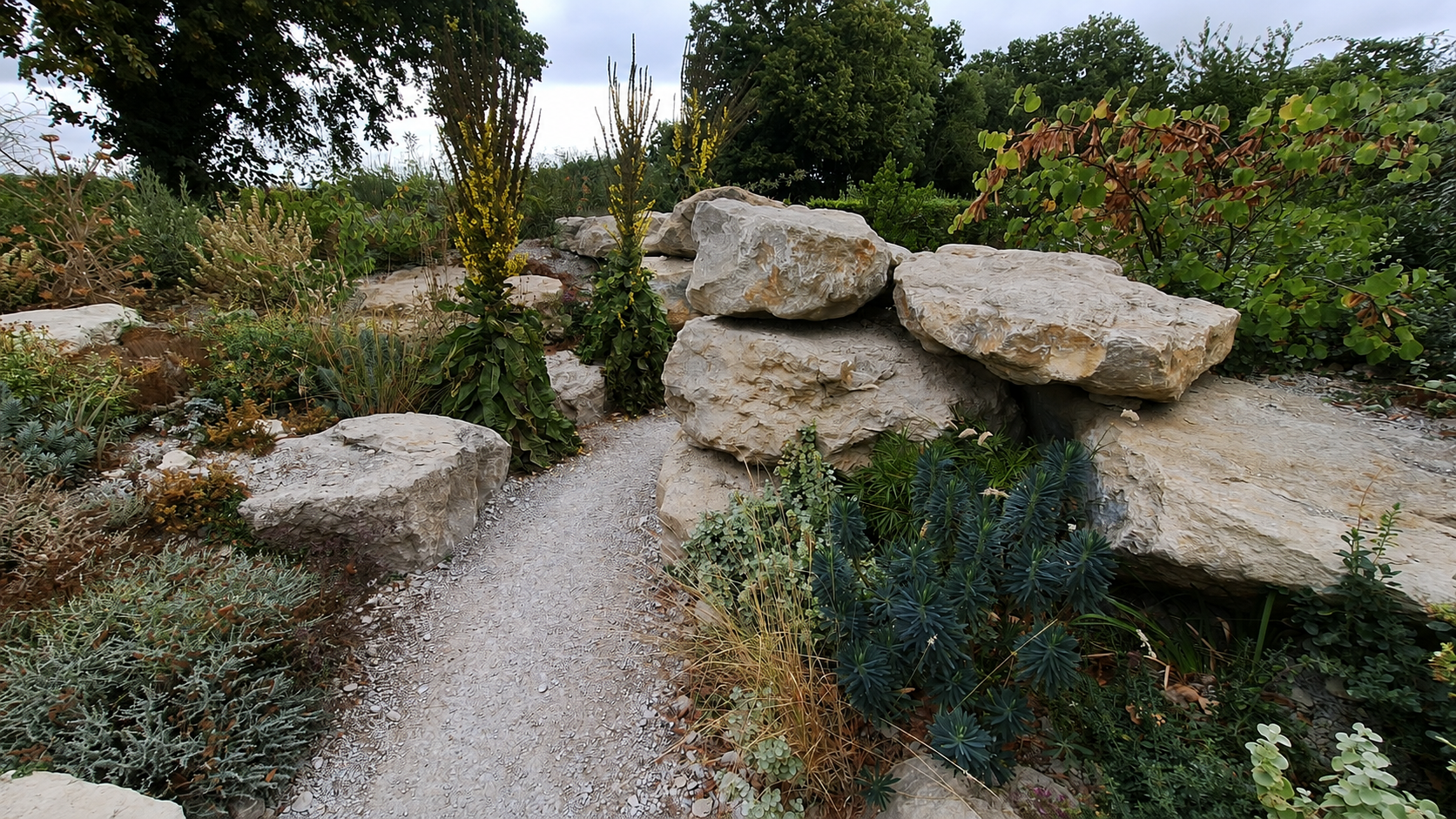
What the Delos garden at Sissinghurst can teach us about resilient planting, free-draining soils and choosing plants for hotter, drier summers.
I visited the Delos garden today, at the Sissinghurst Estate in Kent. This National Trust property was owned by Vita Sackville-West and Harold Nicolson until 1962 — and it remains one of the most visited and admired gardens in England.
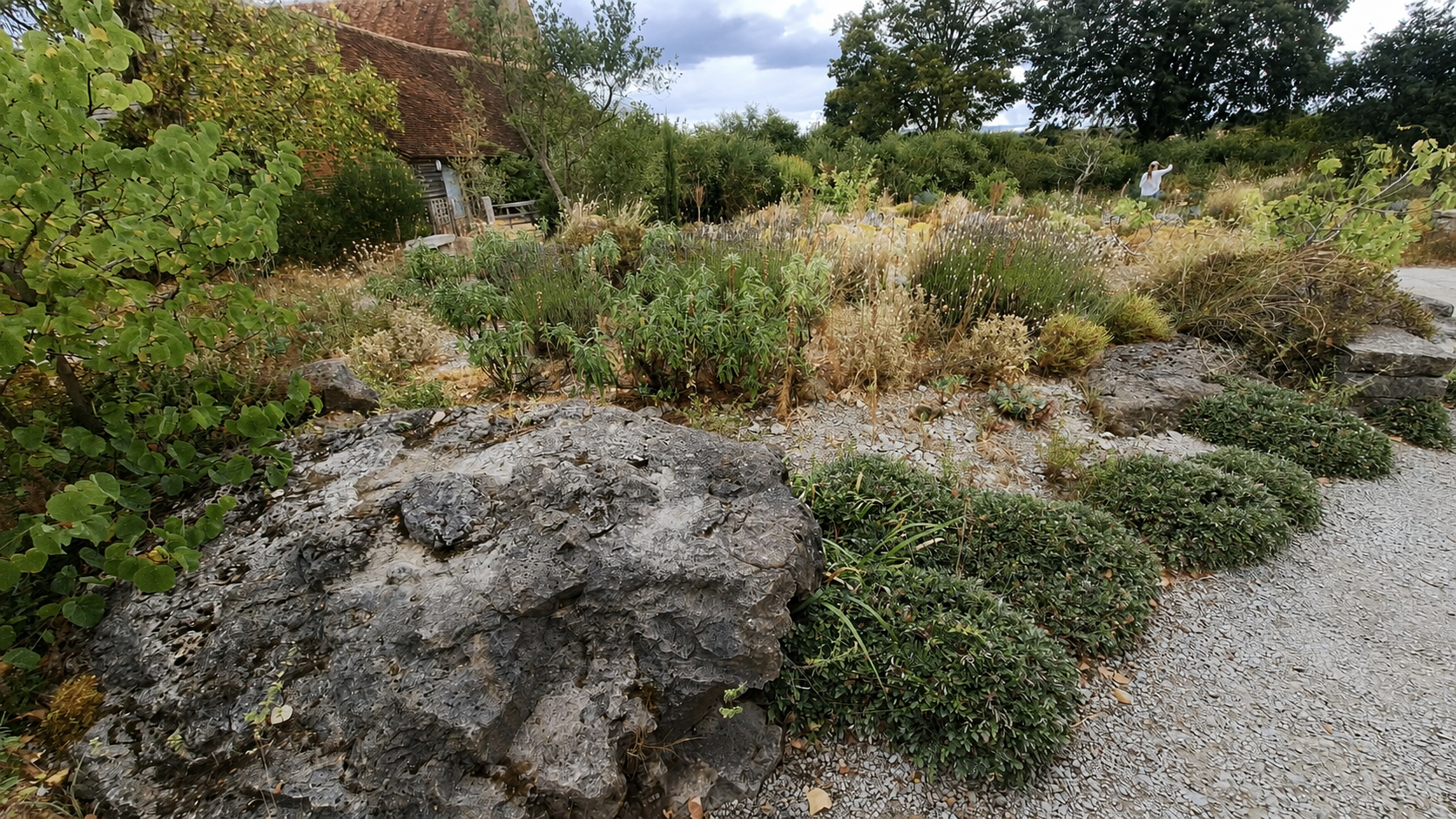
My reason for going was specific: I wanted to see how Dan Pearson's design and planting was holding up after five heatwaves. It still looked stunning, and was proving a hit with visitors young and old.
Who is Dan Pearson?
Dan Pearson OBE is a highly celebrated, award-winning British landscape designer, responsible for the modern reimagining of the Delos dry garden at Sissinghurst. While his wider signature style is more naturalistic, ecological, and painterly in its approach to perennial planting, he has become a leading authority on climate-resilient and dry-garden design.
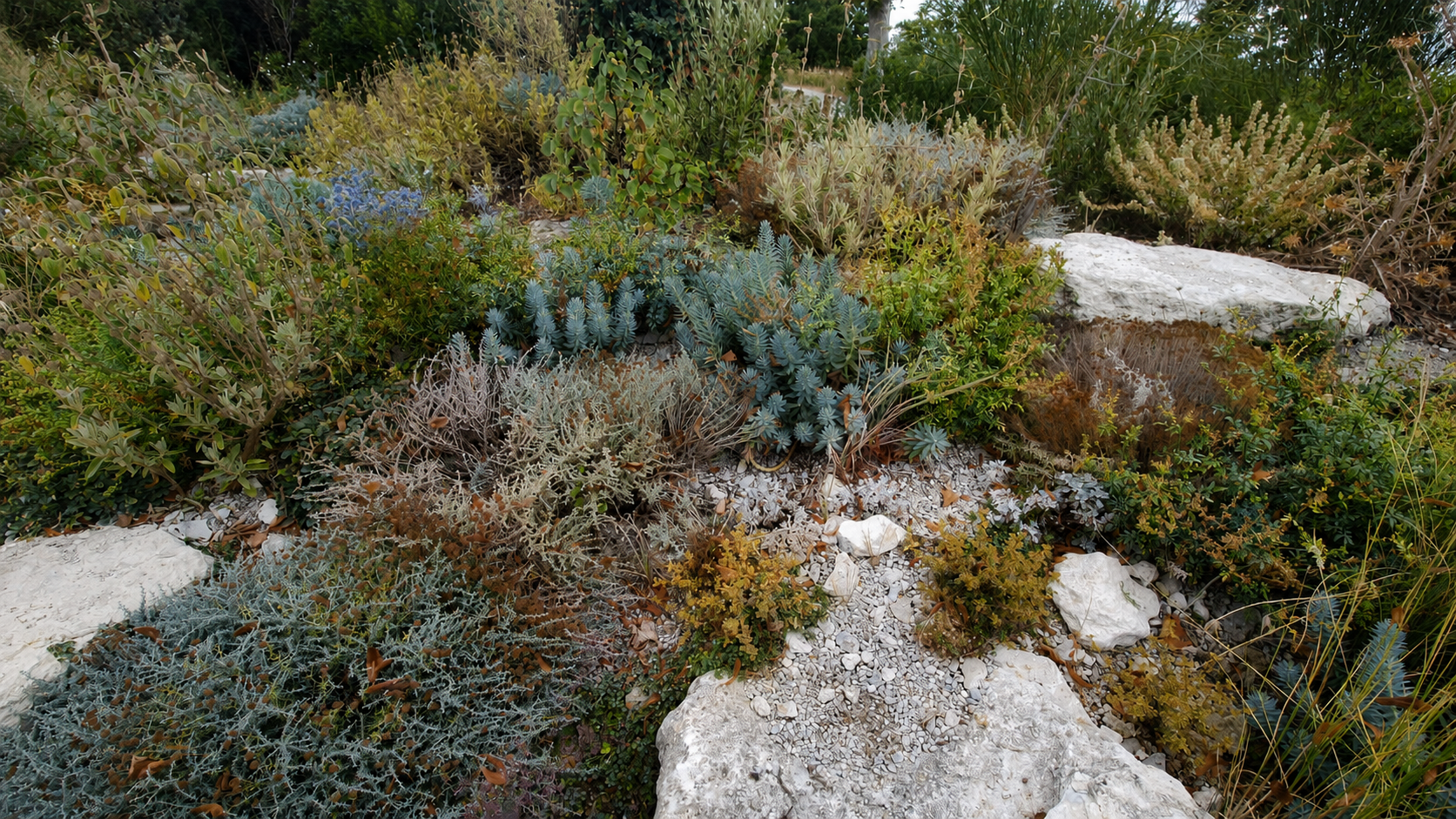
His planting palette for Delos spans different climate zones to cope with the land's topography — without needing to water. The result is sun-baked terraces with a cooler, shady 'ravine' that emulates a Mediterranean gorge.
Why does it survive UK droughts?
The Delos garden survives UK droughts and hosepipe bans because the soil is different. In fact, it is not soil at all.
What we expect in our own gardens is a mix of clay, sand and silt. Here it is 60cm of free-draining grit and aggregate — more akin to an arid, rocky scrubland in Greece. Species such as rockrose, cypresses, and phlomis rely on deep, naturalised root resilience rather than regular irrigation.
For gardeners planting in a similar substrate in Kent or Sussex, plants need to be supported after planting in spring so they can adapt and create this deep root resilience over time.
What we can learn from the Delos garden
The design strategies at Delos are not just beautiful — they are practical lessons for any gardener dealing with dry summers and unpredictable rainfall.
Free-draining root zones
Beds are terraced and built with sharp grit and crushed brick to prevent winter wet-rot on dry-loving roots. This is something you can replicate on a smaller scale in raised beds or borders.
Silver and hairy foliage
Plants like Greek horehound and Stachys feature downy or reflective leaves that bounce harsh light and minimise moisture loss. If a plant looks silvery or felted, it is usually telling you it can handle heat.
Aromatic oils
Tough shrubs like rockrose and thyme hold volatile oils that reduce transpiration during baking summer heat. These are not just fragrant — they are a survival mechanism.
Ephemeral self-seeding
Short-lived annuals and poppies drop seed into gravel to naturally cycle through wet and dry seasons without human intervention. Once established, they look after themselves.
Tips for planting in Kent and Sussex
If you want to bring some of the Delos spirit into your own garden, here is where to start:
- Study the design strategies and plant palettes used by Dan Pearson at Sissinghurst. The National Trust website and the Sissinghurst Castle Garden Facebook page carry regular updates and insights from senior staff.
- Visit regional dry-planting pioneers like the Beth Chatto Gardens in Essex for proven gravel-gardening templates that work in our climate.
- Observe natural pairing behaviours between structural evergreens (cork oak, myrtle) and low-lying perennials (euphorbias, salvias). These combinations are not accidental — they reflect how plants grow together in the wild.
Plants seen in the Sissinghurst Delos layout
One of the most useful things you can do on a garden visit is take notes. Here is what I spotted:
Canopy & structural layer
- Cork oak — Quercus suber
- Pencil cypress — Cupressus sempervirens
- Fig — Ficus carica
- Judas tree — Cercis siliquastrum
Middle tier — shrubs
- Cretan rockrose — Cistus creticus
- Smokebush — Cotinus coggygria
- Lavender — Lavandula angustifolia or L. × intermedia
Lower tier — perennials
- Greek horehound — Pseudodictamnus acetabulosus
- Mediterranean thyme — Thymbra capitata
- Yarrow — Achillea coarctata
- Gopher spurge — Euphorbia rigida
- Mullein — Verbascum olympicum
- Clary sage — Salvia sclarea
Ephemerals & ground layer
- Hairy melic grass — Melica ciliata
- Wild poppy — Papaver rhoeas
The Delos garden is proof that climate-resilient planting does not mean sacrificing beauty. With the right plant choices and a willingness to rethink what we put in the ground, our Kent and Sussex gardens can be just as resilient — and just as stunning — as anything you'll find at Sissinghurst.
This article draws on expert horticultural guidance. For more detail, visit the RHS website and the Sissinghurst Castle Garden page.
Share this tip
Instagram doesn't support direct links — copy this caption and paste it into your post.
More tips
Browse all our expert gardening tips for Kent and Sussex gardens.